
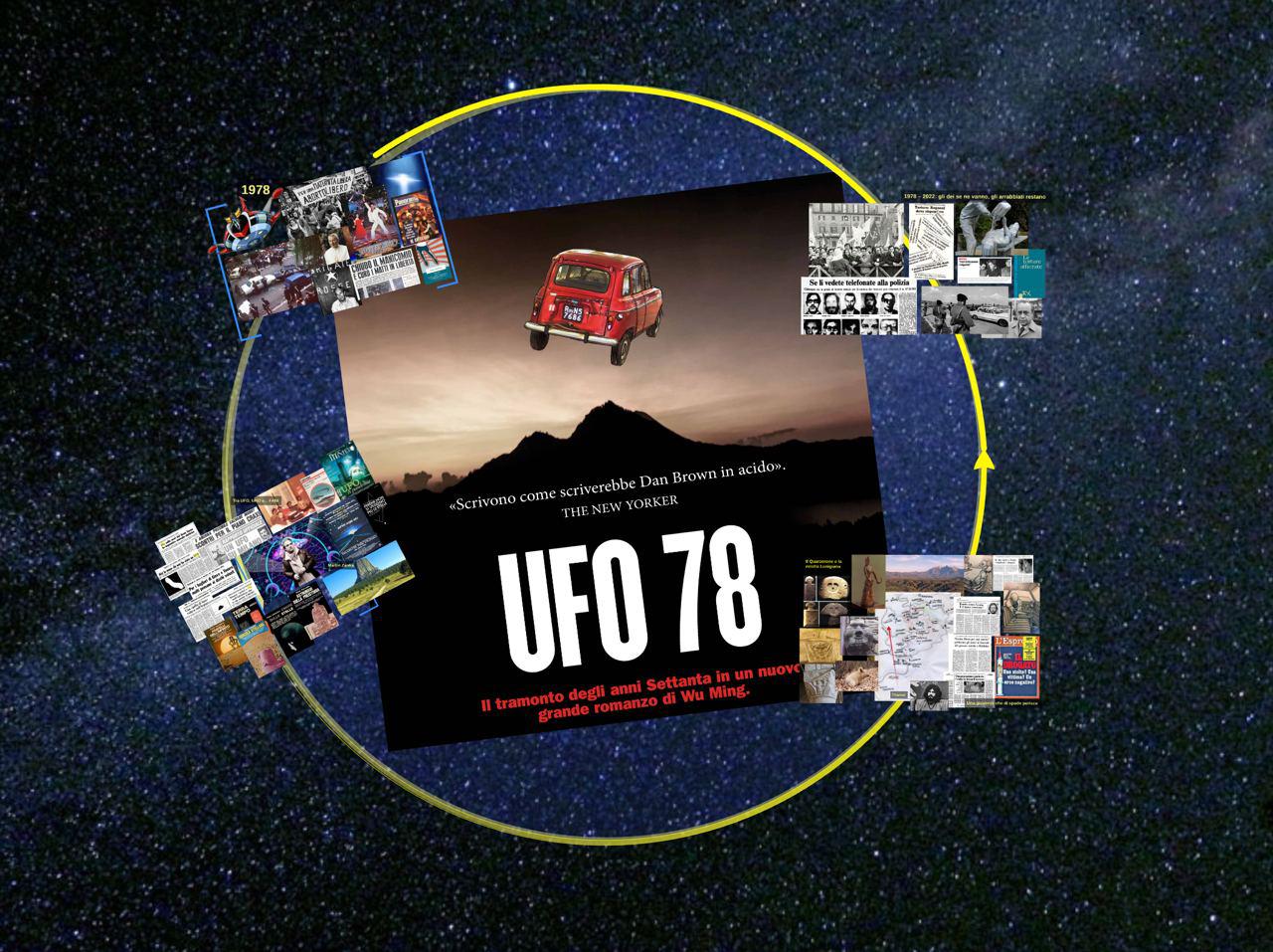
In 2025 the Spanish edition of our novel UFO 78 – published by Anagrama with the title Ovni 78 – was distributed in several Latin American countries, including Argentina, Chile, Mexico and Uruguay. In January 2026 we gave an interview to a Mexican news website. We received the questions in written form, there was a huge lot of them and they were, er, ambitious, meaning that they required complex answers. We worked on them thoroughly, and then we sent them (in English), and then nothing came of it. For some reason the interview was given a red light. Two months have passed and we think it’s time to publish this stuff ourselves. At least it won’t end up in the dustbin.
In other novels you explored practices like mesmerism, spiritualism, or hypnosis. Now, in Ufo 78, you delve into ufology. With the Pentagon recently acknowledging Unidentified Aerial Phenomena (UAP) and magnates aspiring to colonize space, how has the fascination with extraterrestrial life evolved? Is there still room to imagine life on another planet?
First of all, we want to say that talking about UFOs is never just talking about UFOs. There’s always something more involved. Reflecting on Italy’s 1978 great wave of UFO sightings is more relevant today than when we started writing the book. It’s even more relevant than in the immediate post-pandemic period, when the skies, once again, were filled with unidentified phenomena and we tried to understand why.
In 2024 the US Congress discussed a 63-page long Report on the Historical Record of U.S. Government Involvement with Unidentified Anomalous Phenomena (UAP). It made headlines worldwide: “New Pentagon UFO Report: No Evidence of Aliens.” Then in June 2025 the Wall Street Journal published a two-part investigation (1 and 2) documenting several episodes that had been erased from the report, as the Air Force allegedly omitted sensitive details that could expose secret programs or harm the careers of senior officers.
Essentially, for decades the Pentagon deliberately spread misinformation about UFOs, encouraging speculation and fueling suspicions of institutional cover-ups. Cover-ups actually existed, but were of a different nature. The main goal was to mislead, covering secret programs like testing stealth aircraft, such as the F117 Nighthawk. These tests were allegedly conducted at the notorious Area 51. The belief that engineers were conducting reverse engineering on alien vehicles served to disguise flight tests. The F117 was later used to bomb Afghanistan, Iraq, and Serbia.
The implementation of stealth technology marked the beginning of a process making aerial warfare increasingly secure for those conducting it — using drones and AI, operating from unreachable altitudes or from bases hundreds of miles away — and increasingly lethal for those who suffer it, almost always helpless civilian populations.
In every era, anomalous phenomena in the sky speak to us, telling us something about the world and ourselves. So what do they tell us about today? They tell us about Gaza, Kharkiv, Iraq, Afghanistan, Yemen…
The other issue is capitalist colonization of outer space, which of course didn’t start with Elon Musk‘s fantasies, and not even with Reagan’s Star Wars program, but was prepared through a very long cultural work. The mythology of space flight is now taken for granted thanks to layers and layers of narratives we consumed for decades. This mythology has reached its most degraded, squalid form in 2021, when Jeff Bezos flew into suborbital space aboard the New Shepard capsule built by his own company Blue Origin. Space flight as a pastime for billionaires is certainly an obscenity, however, that launch wasn’t just for fun. Such publicity stunts are integral parts of the plan to fully subject the sky to capital. A sky that is already crowded with machinery and debris.
We’ve collectively embraced a false belief: that humans can exist away from this planet, in a synthetic environment, separate from the conditions that sustain our microbiota — the incredible “cooperative” of bacteria and fungi forming nearly 50% of our gene pool. Without them, we wouldn’t be us. These are relatively recent discoveries, and they help us understand our unity with our planet, and how out of place we would be in outer space. The myth of space flight, it turns out, is based on ignorance of our being, of who we are.
In the meantime, all those stories of space travel have made the option of abandoning Earth thinkable. Instead of fighting to change the world, more and more people think that someday humans will leave this planet, finding a new one to terraform, colonize, exploit, and consume, just like we did with Earth. Pure colonialism. In his book The Nutmeg’s Curse, Amitav Ghosh explains that the myth of exo-planetary terraforming wouldn’t be possible without the endo-planetary terraforming that was enacted in the Global South through colonialism.
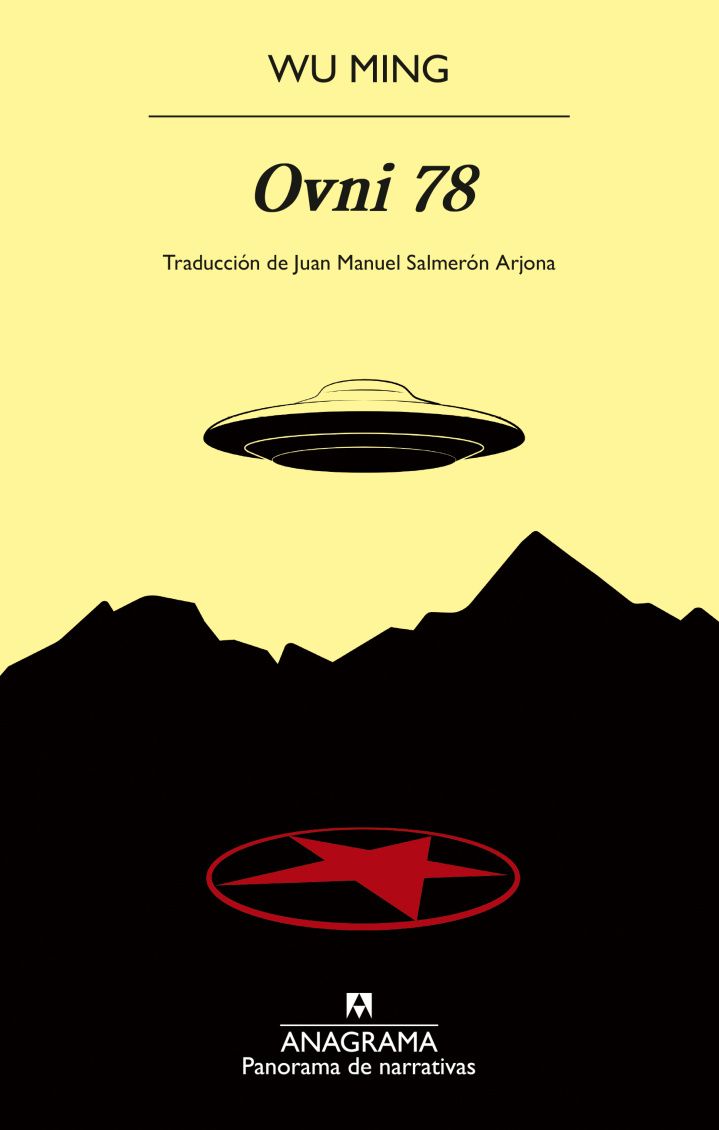
Ufo 78 intertwines the wave of sightings in 1978 with the kidnapping and murder of Aldo Moro. For the Latin American reader less familiar with Europe’s ‘years of lead’: What changed in Italy after that assassination, and what is considered to be its impact on the rest of Europe?
In the 1970s Italy experienced extremely radical social conflicts. This was countered by many black operations by several intelligence – actually, counterinsurgence – agencies. Italy was one of the most important outposts of the Cold War, because it bordered with Yugoslavia, had the most powerful and influential Communist Party in the Western Hemisphere and was (still is) at the center of the Mediterranean, therefore it was dangerously close to Gaddafi’s Lybia, the Middle East and so on.
In 1948 the CIA and the Vatican did all they could to make the Christian Democrat Party win the national election, they even staged appearances of the Virgin Mary all across Southern Italy. It goes without saying that Our Lady gave people precise instructions on how to vote. That was the beginning of the so-called K Factor, which meant the the Italian Communist Party (PCI) and its allies had to be kept out of national government, in spite of getting more than the 30% of votes (and keeping that percentage well into the 1980s). In the meantime, Italy rapidly became one great aircraft carrier for the US, with about 120 US and NATO bases across the country.
After what we call l’Autunno caldo [Hot Autumn], i.e. the general workers’ strikes of 1969, huge and radical mass mobilisations faced the fiercest repression by the powers-that-be. The 1969-80 campaign of covert operations against social movements, unions and generally the Left is remembered as the Strategy of Tension. Clandestine armed groups like the Red Brigades were one of the options militants took in that extremely violent context.
In 1978 Aldo Moro was, first and foremost, a name. A name that Italians had heard almost daily for thirty years. Moro was a powerful man, a seasoned politician, and a symbolic figure of the Christian Democratic party which governed Italy since 1948.
However, during the days of his abduction by the Red Brigades Aldo Moro became the name of something else. Moro found himself in three prisons: the first was the actual one, a very tiny room in a Roman apartment; the second was his past and political career: he’d been abducted because of it; the third was the most oppressive one, the so-called Linea della Fermezza [line of firmness], i.e. the immediate and complete refusal of starting any negotiation, a stance taken and defended by Democrazia Cristiana, by the Communist Party (which by then was advocating “national solidarity” and a “historic compromise” with DC), and major newspapers.
Moro wrote numerous letters to his colleagues and other politicians, proposing political solutions to his abduction. He fought hard to escape those three prisons. He quickly discovered that, as said before, the worst one was the third. “Firmness” was a mechanism that prevented Moro from being heard, altered the meaning of his words, and generated various conspiracy theories. In fact, the government publicly declared Moro incapable, lost in an altered state of mind, possibly drugged or hypnotized, thus his letters were not considered true expressions of his will.
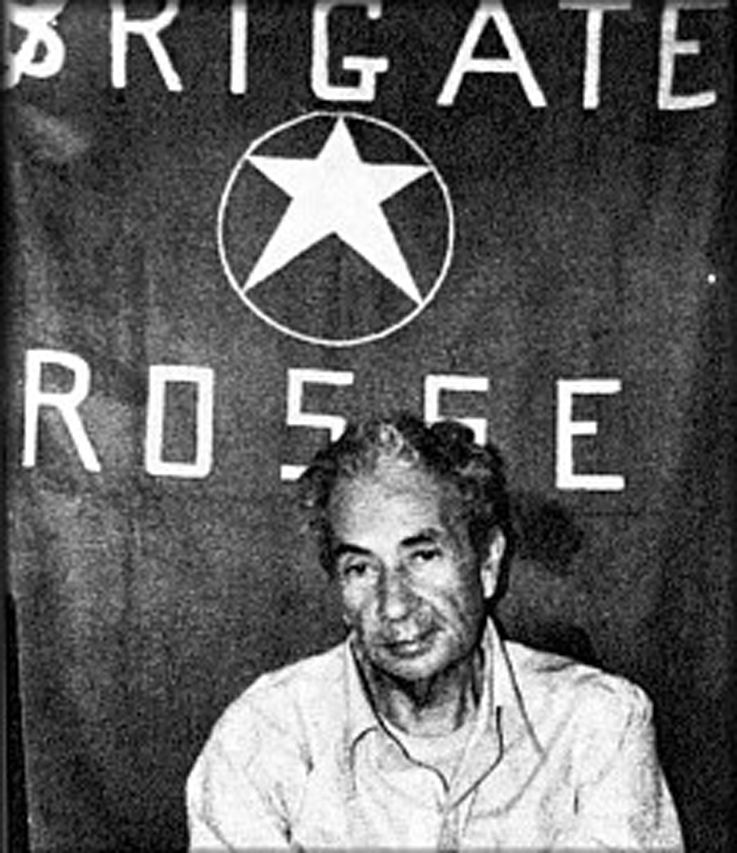
March 19, 1978: Aldo Moro in the “People’s Prison”.
In the Italian society, Moro’s tragedy was recognized and perceived by many. We believe that many people, even those voting for the parties supporting firmness, started to identify with this “new” Moro, ie with an imprisoned, unheard, denigrated, powerless man who had been abandoned by the same powers he represented until just days before. As shown in numerous literary and cinematic works, from The Count of Monte Cristo to Trading Places, sympathizing with those who suffer a reversal of fortune is natural, regardless of who they are. If we also take into account what Jimmy Fruzzetti says in UFO 78, that in prison stories, people always root for the one who escapes, then it seems unlikely that Italians, at least in their subconscious, didn’t root for Moro’s liberation.
However, the line of firmness left no room to express that sentiment without risking being labeled as a Brigadist supporter. You had to side either with the State or with Terrorism, no third option. People felt themselves trapped during the day, and started to look at the skies in search of UFOs during the night.
As we know, the whole Moro affair went in the worst possible way and had a very bitter ending. In the following years, a repressive and reactionary grip started to tighten on the country, marking the end of a period of struggles, social conquests, and cultural richness, as Italy, like the rest of the West, entered its long phase of neoliberal dominance, individualism, and economic horror.
Nearly fifty years after, we’re still prisoners of “infernal alternatives”, as Isabelle Stengers would say. You have to side with the “West” or with “Its Enemies”, no complexity is allowed. In Europe this rhetoric has been brought to fever pitch. If you don’t take sides you are pointed out as no less than a foreign agent.
The anthropologist Milena Cravero is one of the most endearing characters as she embodies one of the novel’s leitmotifs: the possibility of inhabiting an interstice and approaching fantasy without abandoning reason. Today, the internet has multiplied or made ‘geek’ or marginal communities more visible. What other groups, currently ridiculed by public opinion, capture your interest?

The French edition of Wu Ming 1’s La Q di Qomplotto.
We’re very attentive to conspiracy fantasies, one of us wrote a book on this issue called La Q di Qomplotto, unfortunately not available in Spanish. To give a hint of our approach, we can use as an example the communities formed around the fear of “chemtrails.” We wrote extensively about them. We think that these narratives develop around important kernels of truth, such as the military use of cloud-seeding techniques, the climate impact of air traffic, and the dangers of solar geoengineering.
The term “truth” is burdened by centuries of philosophical speculation, and has yet to recover from decades of “linguistic turn” and deconstructionism. That’s why the phrase “kernels of truth” may raise eyebrows. But the truth we talk about is relative and contextual. The kernels of truth that we seek in conspiracism are elements that we anti-capitalists can recognize as part of our experience and worldview. Starting from these elements, we can establish contact with those who believe in conspiracy fantasies, and seek common ground without adopting what we call “ratio-suprematism”, without any superiority complex, and without thinking, like debunkers do, that we can solve these problems by simply “popping balloons with a needle”.
When we say that we need to engage with those people, we don’t mean the full-time peddlers and sellers of conspiracies. It’s not the greedy influencers we need to reach, but the angry and anxious people, those that feel humiliated and crushed by the state of things, who feel how rigged and destructive this system is and think they’ve found the explanations they need in certain conspiracy fantasies.
Maintaining a certain anonymity in the era of social media, where identity is a showcase, seems like a countercultural choice. What literary or political benefits does it offer? How do they prevent the mystery from turning into mere marketing?
Ours is not really anonymity. Our names and basic biographies aren’t a mystery, they can be found on our website, as well as on Wikipedia. We just refuse being photographed or filmed, and don’t share details about our private lives. We certainly don’t live in hiding: we participate in hundreds of meetings, events, and public initiatives each year, appearing in the flesh and building relationships with others. Anonymity is often a marketing tool. In our case, there’s no secret to unveil, no mystique around the author’s name or identity.
The benefits are primarily practical and vital: our books can succeed without turning us into celebrities, which certainly makes our life better, because — as Pier Paolo Pasolini once said — “success is the other side of persecution”. If someone recognizes us on the street, it means they’ve met me us in person, not seen us in a photo or on a screen. This makes the experience more pleasant and the connection more meaningful.
From a literary standpoint, the media opacity of our faces and private lives keeps the focus on what we write, which is what truly matters. Finally, from a political point of view our policy has not only a countercultural value: it implies withdrawing our image from an economic system that could use it in various horrible ways, for example, to train weapon targeting systems, facial recognition machinery, and programs creating toxic videos and deepfakes. It’s a critical gesture, but above all, a gesture of resistance.
You were pioneers in the use of copyleft. A couple of years ago, some Mexican authorities were determined to crack down on pirate libraries releasing books online, arguing that they affected sales. You’ve achieved an agreement with publishers: your books are freely accessible yet are a sales success. How do you explain the fact that free circulation hasn’t harmed your sales?
More than twenty-five years ago, when we published our first novel with a major publisher (Einaudi), we faced the challenge of reconciling free access to culture, which is a collective product, with fair compensation for a writer’s work, not just our own work. We devised a formula similar to today’s Creative Commons licenses, which didn’t exist at the time. In 1999, digital reading devices were in their infancy, and publishers were mainly worried about photocopying.
Certainly, the ability to download the text of that novel from the Internet didn’t harm bookstore sales of the physical copies. If anything, it served as an incentive: those who read the free version talked about the book with others, recommended it, and bought it to give it as a present. Free downloads led to greater circulation of the text, which benefited commercial sales, much like word-of-mouth advertising.
Today, reading on screens is more common, but that doesn’t mean a download from a digital library counts as one less sale in a bookstore. Those who access a story for free wouldn’t necessarily buy it if that option were removed. And the story would miss the opportunity to find a home in another mind.
The balance we’ve achieved between free access and compensation is undoubtedly destined to change. Nothing lasts forever. Nevertheless, we are convinced that labeling the free circulation of cultural products as “piracy” is entirely useless, or even counterproductive. If such an attitude had become widespread centuries ago, we might not have public libraries today, which are a cornerstone of human knowledge.
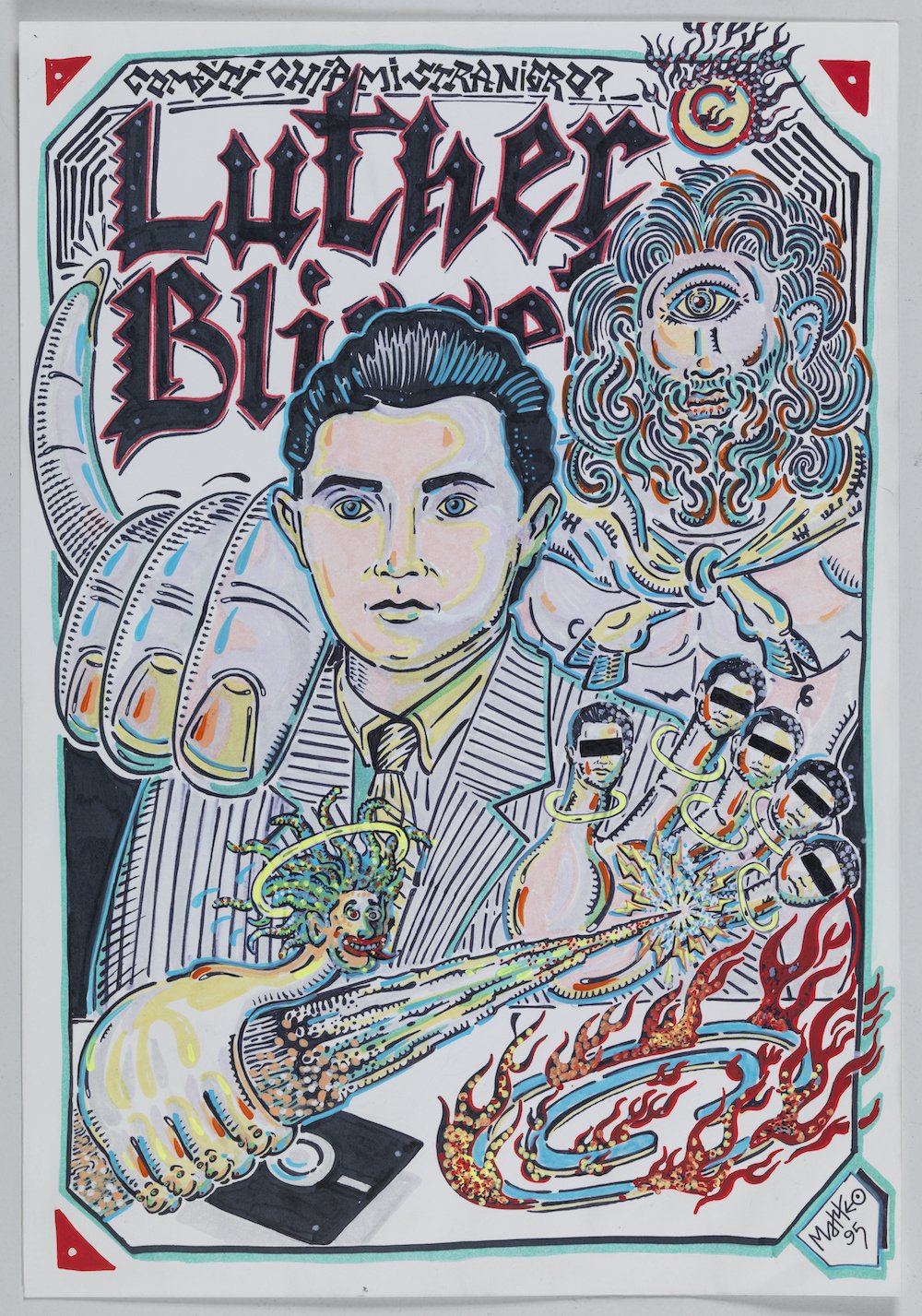
Matteo Guarnaccia, “What’s Your Name, Stranger? Luther Blissett,” mixed media on paper, 1995. High-definition version here. The original is at MART in Rovereto, part of the Piermario Ciani Collection.
One tactic of the Luther Blissett Project was fabricating fake news to destabilize media. Today, disinformation is one of the main tools of the far right. What do you think of this evolution and the comparison of, for example, QAnon with your character ‘Q’?
Luther Blissett’s media hoaxes took place in the mid-1990s. At that time, complaints about the power of the media to spread unchecked falsehoods were common. Looking beyond complaints and getting organized, many activists focused on “media education” or grassroots journalism, such as the Indymedia network, which encouraged the creation and dissemination of alternative information. Luther Blissett took a third approach: if the media lies to you, lie to the media. Create tomorrow’s headline news yourself.
These actions had two purposes: one that we called homeopathic and the other educational. On one hand, we aimed to cure the disease (informational system lies) with a small toxic dose of stuff with similar effects (our fake news). On the other, our “scoops” – for which we promptly claimed responsability, explaining how we had worked – targeted similar media-created “scoops” to expose their mechanisms and dynamics. There was no intent to deceive anyone except the editorial staff of a newspaper or newscast, and only for a limited period of time, until the prank was revealed.
Today, we can say that the therapeutic goal failed, while the educational one succeeded. Knowledge, even practical, of informational system glitches has grown immensely. The creation of fake news is accessible to anyone and there’s increased awareness of its functioning on both cognitive and emotional levels, to the point that more and more people understandd that “debunking” is not enough. The challenge no longer lies in fabricating fake news, nor in merely dismantling them, like revealing a magician’s trick. Whoever does that is perceived as a killjoy destroying the magic. A “balloon piercer”, as we said before. The task is to find a way to defuse the hypnotic component of the magic while preserving wonder; to reveal the trick engagingly and replace it with something equally astonishing.
The juxtaposition of QAnon and our character “Q” is testimony that times have changed. According to some, QAnon started as a prank on the American alt-right: the invention of a spreader of lies and legends, to show how foolish those people are. Just like the papal spy signing with “Q” in our novel misleads opponents with false information. If Qanon was intended as a prank or a parody, it certainly escaped its creators’ control, becoming something else entirely, because thousands were ready to believe those fabrications. This demonstrates the ineffectiveness of parody, just as our homeopathic cure was ineffective thirty years ago.
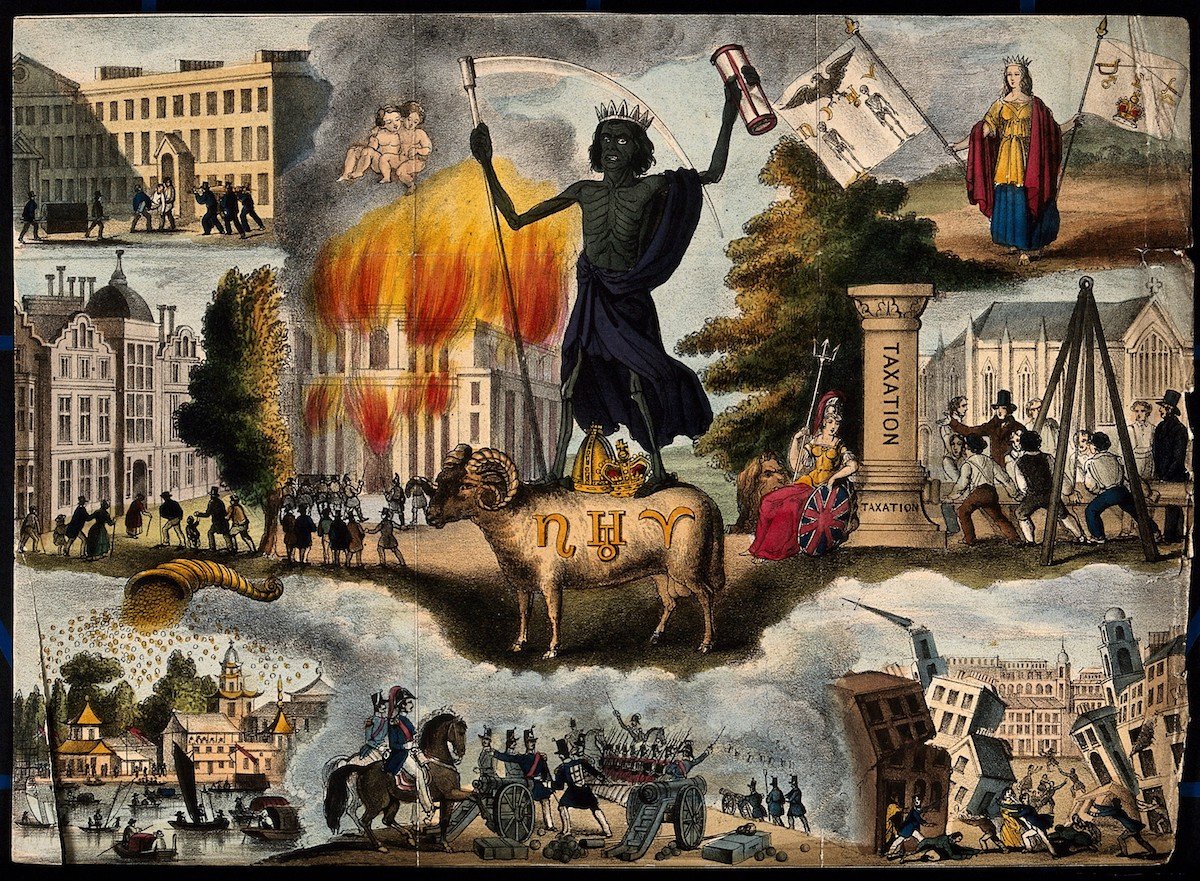
Color lithographs taken from the 19th-century magazine Prophetic Messenger, also known as Raphael’s Almanac.
Ufo 78 is a novel that matured over many years but was mostly written during the pandemic, an event that brought us closer—as a species—to a post-apocalyptic feeling. What mark does that collective experience leave on the novel?
The pandemic had a significant impact on the writing of the novel, slowing it down almost to a halt for about a year.
Initially that was because our way of working is based on being together in the flesh, sharing a room while brainstorming. Remote meetings aren’t creative, as their sequential structure — I speak first, then it’s your turn etc. — deprives the meeting of its convivial nature, which we found to be irreplaceable.
On the other hand, the extraordinary event we were experiencing pushed us to write directly about it, using our website Giap as a place of political discussion and mutual support between hundreds of people questioning the meaning of what was happening.
This search for meaning brought to mind other “exceptional” periods, of special laws, widespread control, obligatory dichotomies, and repression, just like the days of the Moro abduction, which we were recounting in UFO 78.
It’s no coincidence that another common element between the two eras were UFO sightings. After that Great Wave, 2020 again registered a new spike in sightings and close encounters. Reflecting on this led to the “ufophile” explanation of the phenomenon we propose in the novel. That is, in “identification-imposing” moments — military checkpoints, document checks, mandatory passes, and pressures to take “either this side or that” — the desire for the “unidentified” grows, the wish for something that escapes classifications, borders, and confinements. That’s what UFOs do, and this desire leads people to see them, meet them, and dream of their arrival with eyes wide open.
